

It’s planning season. Across building products, leadership teams are forecasting budgets and finalizing growth targets.
Yes, marketing has more riding on these plans than ever. In fact, Gartner’s latest CMO survey shows budgets ticking up to 7.8% of company revenue… with more than 15% of that now earmarked for AI.
Nearly three in four CMOs describe the growth expected of them as high – very high – or overly ambitious.
The investment is real. Proof nevertheless, is still on its way. As evidence, PricewaterhouseCoopers claims only 12% of CEOs have seen both revenue gains and cost savings from AI to date.
Bringing a sharper realization to planning meetings… everyone wants growth. The hard part is knowing when it will arrive. Rather than waiting for the bottom line to be confirmed in the rear-view mirror.
Experience reminds us that growth is ultimately an outcome. Comprised of a series of signals.
Here’s how to read them well… while the music continues to play.
GROWTH ISN’T ONE NUMBER
Ask five executives what growth means, and there may be five answers. McKinsey found that CEOs and CMOs – at the same companies – agreed on their top three metrics only half the time.
CEOs tend to focus on business outcomes such as revenue growth and margins. While CMOs are not surprising… they often report measures such as brand awareness.
They’re both measuring different parts of the same machine.
A challenger brand launch that is chasing adoption shouldn’t leverage the same scorecard as a category leader defending share. A manufacturer selling through two-step distribution needs different signals than another selling direct to builders. Team size – budget and route to market – shape what “working” should look like.
Growth is predictable. And profitable.
Earned across the entire decision-to-sale process – from the first specification conversation – to the final purchase. Every metric should demonstrate how that process is gaining traction.
McKinsey found that roughly 80% of growth comes from the core business. That’s why it is critical to understand what’s actually happening within a brand’s existing customers and its channels.
REVENUE IS THE LAST SIGNAL… NOT THE FIRST
Revenue will be the ultimate proof.
Yet, for building products… the buying cycle is long. An architect specifies today for a project that breaks ground next year. A dealer stocks a new line months before contractors reorder it.
So, when revenue is the first sign that a strategy is working, leadership has waited too long…
To find out.
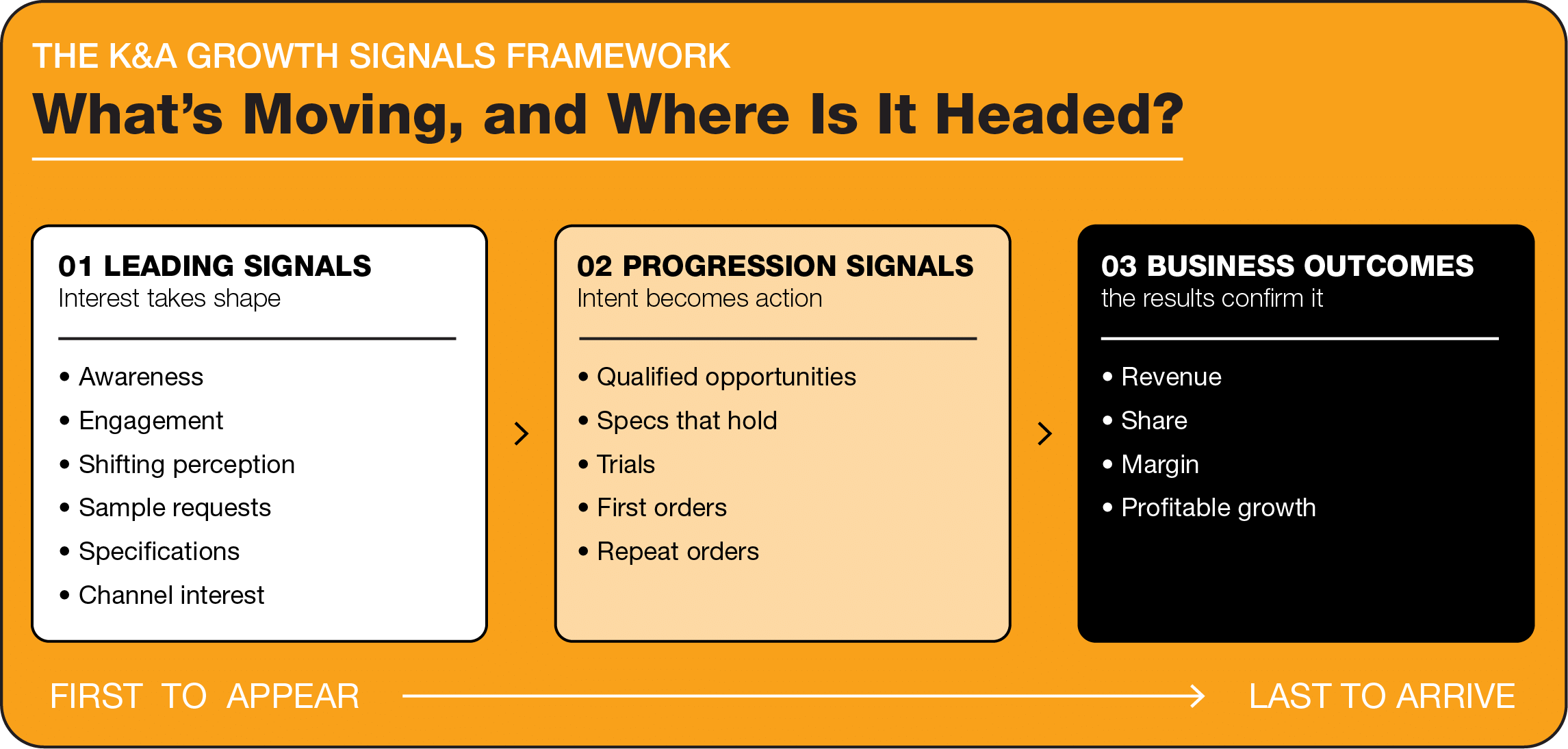
Progression signals follow, as opportunities qualify. Specs hold and trials begin. Ultimately, first orders extend into reorders.
Brand share and margin… arrive last. The point isn’t to downplay recording revenue. It’s to see it coming.
That sequence is the heart of the K&A Growth Signals Framework™.
MEASURE MOVEMENT… NOT ACTIVITY
Impressions. Clicks. Downloads. MQLs.
Those metrics demonstrate activity. But they don’t tell what has changed. A click doesn’t mean an architect is closer to specifying. A lead doesn’t mean a contractor will switch.
The better question is… who moved? In awareness to final specification.
That’s why repeat behavior matters so much. A contractor who reorders three times… reveals more than a hundred who downloaded a spec sheet once.
Real customer intent reveals itself in patterns, not single actions.
MARKET MOMENTUM SIGNALS… WHAT NEVER REACHES THE DASHBOARD
The strongest evidence of growth often fails to be included in reporting. It shows up in conversations.
An architect inquires about a product before outbound sales identifies him as an influencer. Dealers request samples without a promotion. A distributor asks when they can carry the line. Prospects confirm that they already know a brand’s promise. An editor anticipates a booth visit and schedules the appointment before the trade show even opens.
We call these Market Momentum Signals™.
They help create a routine for sales, marketing and channel teams to capture and share the signals that matter most.
It’s as simple as tracking brand perception – with the same questions on a regular cadence – to recognize what’s changing.
Instead of guessing.
THE CHANNEL BLIND SPOT
For manufacturers selling through distribution, there’s another catch. What is shipped into the channel… isn’t what sells through it.
Strong sell-in – followed by flat sell-through – can mean inventory building on shelves. Rather than, demand building in the market. That’s the difference between measuring shipments…
And measuring adoption.
The best signals – who’s reordering and which SKUs are gaining velocity – all remain hidden at distributors and dealers. Rather than prominently displayed for aligned sales and marketing teams to leverage in a CRM.
The answer is a value exchange. Best visibility means smarter demand generation. Better leads. And a more relevant, learning organization.
WHERE GROWTH BREAKS
Because when growth stalls… the cause is rarely obvious. It typically breaks inside one of five drivers. And each leaves a different fingerprint.
A product that repeatedly arrives too late to shape the specification…points to Early-Stage Influence issues.
Lead volume can look healthy while few prospects fit the ideal customer profile. Call that a Demand Generation gap.
When dealers sign on, yet stocking recommendations and sell-through stay weak… Channel Activation is where to look.
Awareness can climb without preference or consideration following it. That’s a classic Brand Authority opportunity.
Sometimes qualified leads enter the pipeline. Then stall… because follow-up, tools or proof points fall short. The gap is Sales Enablement.
The symptom looks the same: slow growth. The signals – causes and fixes – don’t.
That’s why diagnosis must come before prescription.
AGREE ON WHAT COUNTS. THEN CELEBRATE IT.
When marketing celebrates MQLs – sales salutes revenue – and the channel recognizes sell-through… everyone can look successful.
While the company stands still.
The fix is shared KPIs rather than parallel scorecards. A single definition of growth that marketing, sales, product and channel partners all work toward.
Doing more won’t get you there. Getting everything to work together will.
So, simply set milestones…
The first architect specification on a major project. A new national distributor. The 100th trained installer. A customer won through a channel campaign.
Growth isn’t a signal that only leadership can recognize. It’s what an aligned organization believes it can continue to create. Milestones are how each stakeholder recognizes it happening.
For a closer look at the five drivers – and where alignment tends to slip – our Executive Growth Brief walks through each one.
ONE LAST THOUGHT
Planning season is when growth targets are set. It’s also the best time… to decide how you’ll know you’re hitting them.
The challenge isn’t finding another metric.
It’s knowing which signals tell us what is actually moving.
And when it’s all moving… in the right direction.
The brands that win in 2027 won’t be the ones with the biggest dashboards.
They’ll be the ones who agree on what growth means… and know what to watch for.
So, how do you really know you’re growing? The best answer arrives well before the revenue does.
If you’d like to compare notes on the signals worth watching in your business, I’d welcome the conversation: sk@kleberandassociates.com