

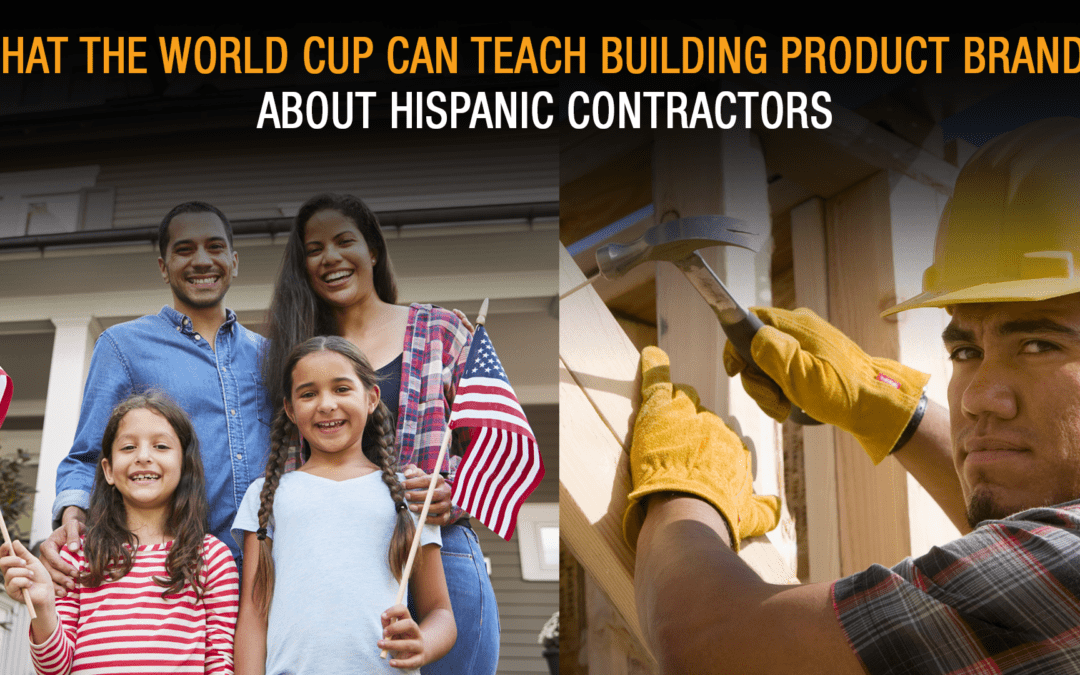
Hispanic contractors and homeowners now represent one of the fastest-growing sources of revenue in building products… and too many brands in this industry are missing important opportunities.
Start with the moment celebrated this past week.
The FIFA “soccer cleat” conversation belonged to the largest marketers in the world.
Nike, Adidas and Puma. The biggest names. The biggest budgets.
We watched as Ferran Torres came off the bench – just past the hour mark – of the final. In the 106th minute he scored the only goal of the match and gave Spain its second World Cup title.
He was wearing Under Armour.
One substitute. One goal. One pair of cleats almost nobody had counted.
Under Armour never bought the tournament. Yet, it owned the moment.
As a challenger brand… overlooked did not mean unimportant.
Importantly, 23.9 million people in the United States watched that goal in Spanish. The most-viewed soccer telecast in Spanish-language media history.
And two weeks earlier, Mexico versus England drew 23.2 million eyeballs, demonstrating the momentum.
That is not a niche audience. That is a market announcing itself in real time.
Hispanic Contractors Are Already Building This Industry
Nearly one in three construction workers in the United States is Hispanic. NAHB puts the share at 32 percent… compared with 19.2 percent across all industries.
Yet, the share understates the dependency.
Between 2018 and 2024, non-Hispanic employment in trades and general labor actually declined by nearly 200,000 workers, according to the National Hispanic Construction Alliance.
Hispanic workforce growth more than covered the gap. Without it, the production side of our industry would have contracted.
Now add the timing. The AGC of America and NCCER 2025 Workforce Survey projects that 41 percent of the construction workforce will retire by 2031.
These are the people lifting the loads. Relying on the instructions. Deciding whether your product will be installed cleanly. Or costs their crew an afternoon.
And responsible for advising the next crew… what to buy.

Hispanic Buying Power Is Outgrowing the Category
The workforce story is only half of it.
This community’s purchasing power in the United States has reached roughly $4.1 trillion, according to the Latino Donor Collaborative. In fact, it is growing about 2.4 times faster than the rest of the country. Latino consumer spending is rising nearly 5 percent a year. More than double the non-Latino rate.
Hispanic households added 441,000 net new homeowners and reached a record 10.2 million last year. That is the largest single-year gain since the Census Bureau began tracking it in 1975. And it happened as homeownership declined across most other demographic groups.
Read that one more time.
Without Hispanic buyers, the United States would have finished 2025 with roughly 125,000 fewer homeowners than it started with.
Hispanic households accounted for 1.1 million new household formations in 2025. Nearly 93 percent of all household formation growth in the country.
Household formation is the leading indicator for almost everything we sell. Windows. Cabinets. Flooring. Fixtures. Roofing.
Latino-owned businesses grew 44 percent between 2018 and 2023, according to Stanford’s State of Latino Entrepreneurship research. Construction ranks among the largest categories.
Please understand that this is not a diversity initiative commentary. Nor is it a corporate gesture.
Rather… this is a growth market.
That your competitors are underpricing.
Reach Is Not the Same as Relevance
The largest advertisers in the world are already aiming narrower. Nike has moved brand spend away from broad campaigns toward athlete-led storytelling inside specific communities. Unilever has committed roughly half its ad budget to creator-led content.
The research behind that shift is instructive. Effectiveness depends on identity, content value, execution and audience fit. Not follower count. Not merely reach.
Building product brands must apply the same discipline here.
Because “Hispanic” is not an audience profile.
Mexican American framers in Texas. Puerto Rican homeowners and Cuban business owners in South Florida. Salvadoran roofing crews outside Washington.
Different markets. Different journeys. Different relationships with language and culture.
Treating them as one universal segment is simply mass marketing wearing a different label.
Translation Is the Starting Line… Not the Strategy
Spanish-language materials matter. Installation instructions. Safety information. Training videos. Warranty explanations. Technical support.
Those resources reduce friction and demonstrate respect.
But a brochure written in English and converted word for word – after the campaign is finished – can be technically accurate. Yet, culturally disconnected.
Relevance requires deciding on the audience before the message is built.
Who appears in the training video? Are Hispanic contractors part of product demonstrations? Reflected in case studies? And included in influencer product integration programs?
Those are not translation tasks.
They are customer experience decisions.
Authenticity Is Priority
Here is the number that informs you how this industry currently sees the audience.
Hispanic workers hold 47 percent of general labor roles in construction.
And they hold 15 percent of management positions.
That gap is not closed with a flag – a holiday – or even a soccer reference. It is closed through participation.
Hispanic contractors must be demonstrating products on real jobsite conditions in sales and marketing campaigns. Bilingual training must support dealer partners. Relationships with Hispanic contractor associations and chambers of commerce must be elevated.
Most importantly, answer the questions crews are already asking. Celebrate business ownership and craftsmanship. Rather than depicting Hispanic workers only as labor.
These organizations already exist at every level, from the National Hispanic Construction Alliance to strong regional groups like the Latin Builders Association in Miami, HACIA in Chicago and the Regional Hispanic Contractors Association in Dallas. In our own team’s hometown community, the Georgia Hispanic Construction Association has served Hispanic construction firms since 2012.
We participate actively. And what stands out for us is not merely the attendance. It is the number of contractors talking about hiring – expanding crews and buying equipment – growing their businesses.
This opportunity is not theoretical.
We listen before we launch. What information is hardest to find? Which instructions create confusion? Who do these contractors trust when trying a new system? What helps an installer become a crew leader… and then a business owner?
Marketing Isn’t the Goal… Commercial Growth Is
Answering that last question is not a marketing exercise.
Consider what must be true for a Hispanic contractor to build a business around a Building Product Brand launch.
Can he reach a bilingual technical representative when an installation question comes up at 7am? Will his distributor’s counter staff know which materials exist in Spanish… and recommend them without being asked?
The rep calling on him has been trained to sell to him. Your certification program has a pathway he can complete. Your warranty process does not require an English-language phone call. And your CRM knows enough about him to tell you whether any of it is working.
Not one of those is merely a communications decision.
Winning with Hispanic Contractors is an Organizational Capability
That is commercialization. Aligning product, sales organization, channels and customer experience around profitable growth.
The difference between the brands making noise in this market. And the companies taking share in it. One is running a campaign. The challenger brand has built a business a growing contractor… will grow inside.
The companies succeeding with this audience consistently excel in five areas.
Strategy. Do you treat Hispanic contractors as a defined growth segment with executive ownership?
Customer Understanding. Do you know where these contractors discover products… and how first-generation, bilingual and English-dominant customers differ?
Marketing and Communications. Is your content built for this audience? Or merely converted for it in translations?
Sales and Channel Readiness. Are your distributors, dealers and reps equipped to serve and sell?
Relationships and Trust. Do Hispanic contractors – in vertical persona panels – shape your product research and development?
That last gap is where the growth is sitting.
“Hispanic contractors are eager to learn and grow their businesses, but manufacturers have to meet them where they are. Training in Spanish — whether through videos, local dealers or hands-on demonstrations — is one of the fastest ways to build trust, expand product adoption and create long-term customer loyalty. Ultimately, long-term success is about building relationships and helping contractors be successful.”
— Kevin Lares, Past Chairman of the Board
Georgia Hispanic Construction Association
Founder, MFC Remodels; CEO, Shower Pans LLC
One Last Thought
Hispanic Americans are building this country’s homes. Starting companies. Forming households. Purchasing products and influencing which manufacturers earn trust on the jobsite.
The workforce numbers – the homeownership and spending analytics – all point in the same direction.
Discounting this community is not a neutral choice. It is a decision to hand growth to somebody else.
The question is not whether Hispanic contractors will shape the future of building products.
The question is which manufacturers they will choose to build it with.
Most building product manufacturers overestimate how ready they are.
Some have bilingual brochures… but no bilingual technical support.
Some attend Hispanic contractor events… but never train their distributor salespeople.
Some translate their website (or leave that to an automated social tool). Yet, ignore to measure and validate specifically how many Hispanic contractors become customers.
That is exactly why we created the K&A Hispanic Contractor Commercialization Assessment™.
![K&A Hispanic Contractor Commercialization Assessment™. Five minutes. You will receive: • Your overall readiness score • Scores across all five commercialization categories • Where you are strongest • Where you are leaving growth on the table • Recommended next steps [Take the Assessment]](https://kleberandassociates.com/wp-content/uploads/2026/07/Hispanic-Survey-Button-Banner02.png)
I’d welcome the opportunity to discuss your score on this brief assessment. And to suggest some initial “next steps” together.
404-918-5700