


Following last week’s midterm elections, Wall Street delivered a decisive vote of confidence to the building products and construction sectors. Major homebuilder equities – Lennar, PulteGroup and D.R. Horton – surged as much as 8% in single-day trading.
While powerhouses Home Depot and Lowe’s experienced sharp, convincing rallies.
U.S. inflation was higher than expected last month and excluding the volatile food and energy categories, core prices rose 0.3%… the same since August. Mortgage applications rose by 6.2% on the week ending November 6 – the sharpest weekly increase since June – according to the Mortgage Bankers Association.
With election uncertainty behind us, the channel is anticipating targeted federal focus on housing affordability. As well as potential supply-side incentives – and legislative momentum – to address the nation’s structural deficit of nearly 4 million homes.
Policy discussions surrounding first-time buyer tax credits, down payment assistance and supply-chain tariff rollbacks will dominate headlines… manufacturing and distribution executives must look beyond political cycles to manage core operational realities.
And to maximize opportunities.
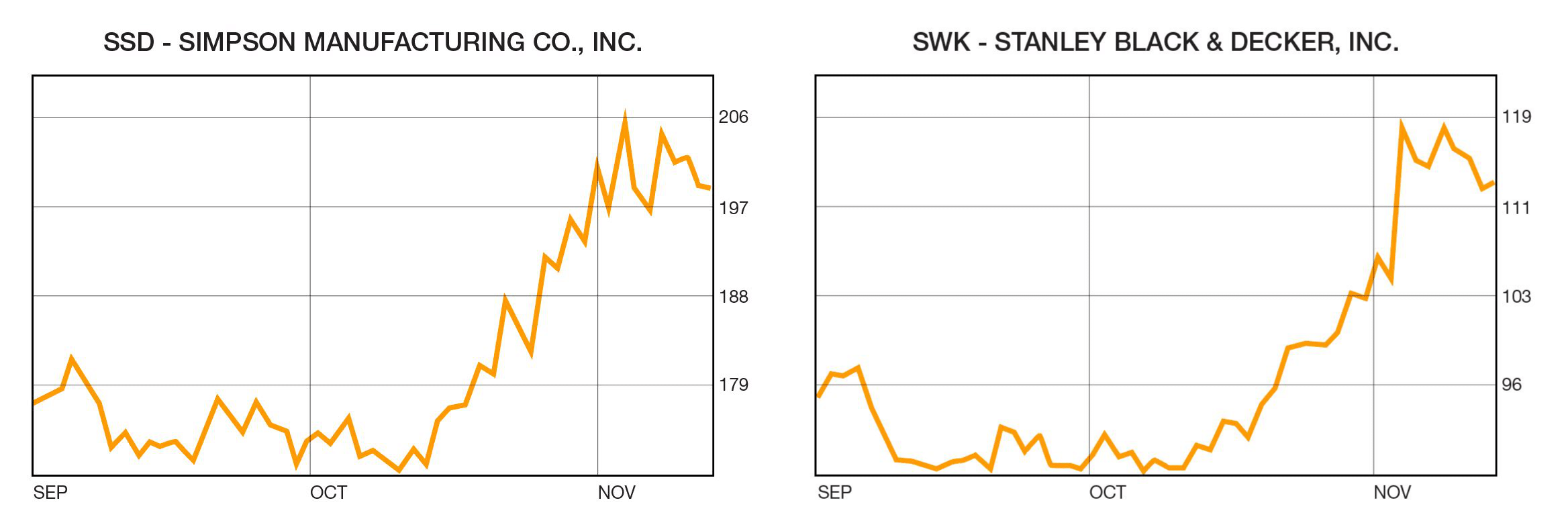
The Macro Picture… Sentiment vs. Fundamentals
As we evaluate the third-quarter economic landscape, building product brands face a bifurcated market…
Characterized by steady structural demand on one end.
And persistent cost and financing pressures on the other.
“Now is a wake-up call,” claims former Federal Housing Commissioner Frank Cassidy. “Senate, House, White House. Everyone needs to get serious about tackling and addressing housing affordability. It can’t be ignored anymore,“ Cassidy said.
New Construction Squeeze
“Since October, rates have improved about 100 basis points,” explains Shannon Hoff, a California-based mortgage broker.
Single-family housing starts remain constrained. While buyer demand remains high… affordability hurdles continue. High land acquisition costs – sticky labor shortages and high material overhead – mean builders are relying heavily on rate buydowns and floor-plan square-footage reductions to protect velocity.
Builders are balancing margins with incentives amid a 5.5% drop in existing-home sales and 5.1 months of supply.
Compressing margins across product categories.
Remodeling Stability
The repair-and-remodel sector continues to act as a crucial economic stabilizer. According to the National Association of Home Builders (NAHB) Q3 Remodeling Market Index (RMI), contractor inquiry volume is rising. And job backlogs are expanding.
What’s more, data from the Harvard Joint Center for Housing Studies (JCHS) projects annual owner-occupied home improvement and repair spending to remain near historic levels of $525 billion.
The typical American home is now over 40 years old, as more than 40 million owner-occupied homes were built before 1980. Each is on its second roof and likely its third. And the windows and siding are not immune from the ravages of Mother nature and time.
Homeowners with sub-4% mortgages are choosing to “remodel in place” maintaining consistent kitchen & bath demand. As well for exterior cladding and outdoor living products.
Commercial & Infrastructure Offsets
While commercial office construction remains muted, industrial, and institutional sectors continue to specify innovative building material solutions at brisk momentum. Brands with agile channel distribution – across both residential and commercial verticals – will continue to be best positioned.

Executive Strategy: C-Suite Priorities for Q4 and 2027
Relying on Washington to deliver relief has never been a reliable growth strategy. Executive leadership across the building products supply chain must focus on four immediate priorities:
- Support the Pro Channel: Pro-contractor backlogs are expanding, yet labor availability remains a persistent jobsite regulator. As such, manufacturers that offer pre-assembled components and simplified installation protocols – with dedicated job-site support – will continue to grow market share.
- Refine the Value Proposition: In a tight-margin environment, sales and marketing messaging must clearly quantify total cost of ownership. Energy efficiency, labor savings and long-term durability… provide measurable ROI for audiences.
- Diversify Channel Exposure: Balancing product portfolios across repair-and-remodel, multi-family and light commercial channels… creates a diversified hedge against single-sector residential solutions.
- Prepare for the Rate Thaw: History is consistent. When mortgage rates moderate as analysts anticipate, homebuying demand will accelerate. Brands that invest in channel relationships, brand awareness and supply chain scalability – during this near-term transitional phase – will lead the next expansion cycle.
One Last Thought
The post-election market rally provides a much welcome boost in industry sentiment.
Of course, “the bottom” for each economic cycle will be revealed in rear-view mirror. Our channel is clearly poised today for where to commit capital – and the sales and marketing strategies required – to sustain profitability.
Sustained success… will require operational discipline.
By focusing on channel support – product value and strategic market positioning – building product brand leaders can now plot a confident course.
While building momentum for the future growth…
That is already shining on the horizon.